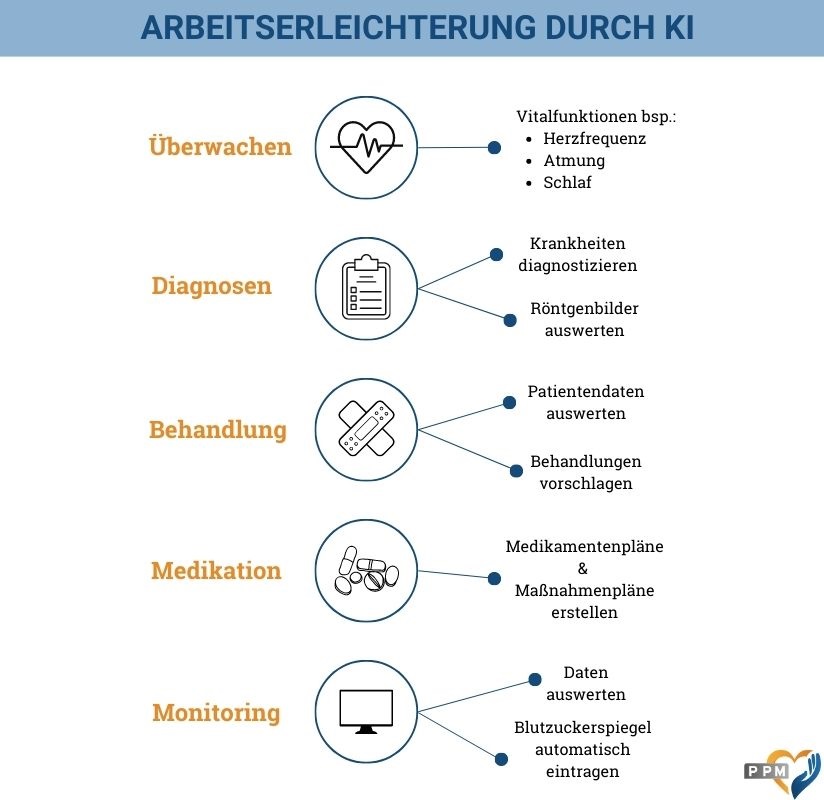
Caregivers of the future: How robotics and AI can support caregivers

The future of caregiving currently has two sides:
Due to the dilemma of demographic change, the number of people in need of care is increasing, as is the number of nursing professionals who will be retiring in the near future. In its 2030 Care Report, the Bertelsmann Foundation estimates that there will be a shortage of approximately 500,000 full-time nursing staff by 2030. While on the one hand, relatives in need of care are increasingly being cared for in inpatient facilities or on an outpatient basis, the number of nursing home bankruptcies is on the rise – a phenomenon that German broadcaster ZDF has dubbed the death of nursing homes'.
On the other hand, digital applications are developing rapidly through machine learning. With the help of artificial intelligence (AI), digital assistance systems and robots are already being used in the care infrastructure. This can significantly reduce the workload of nursing staff and make care more efficient.
Applications of AI in care
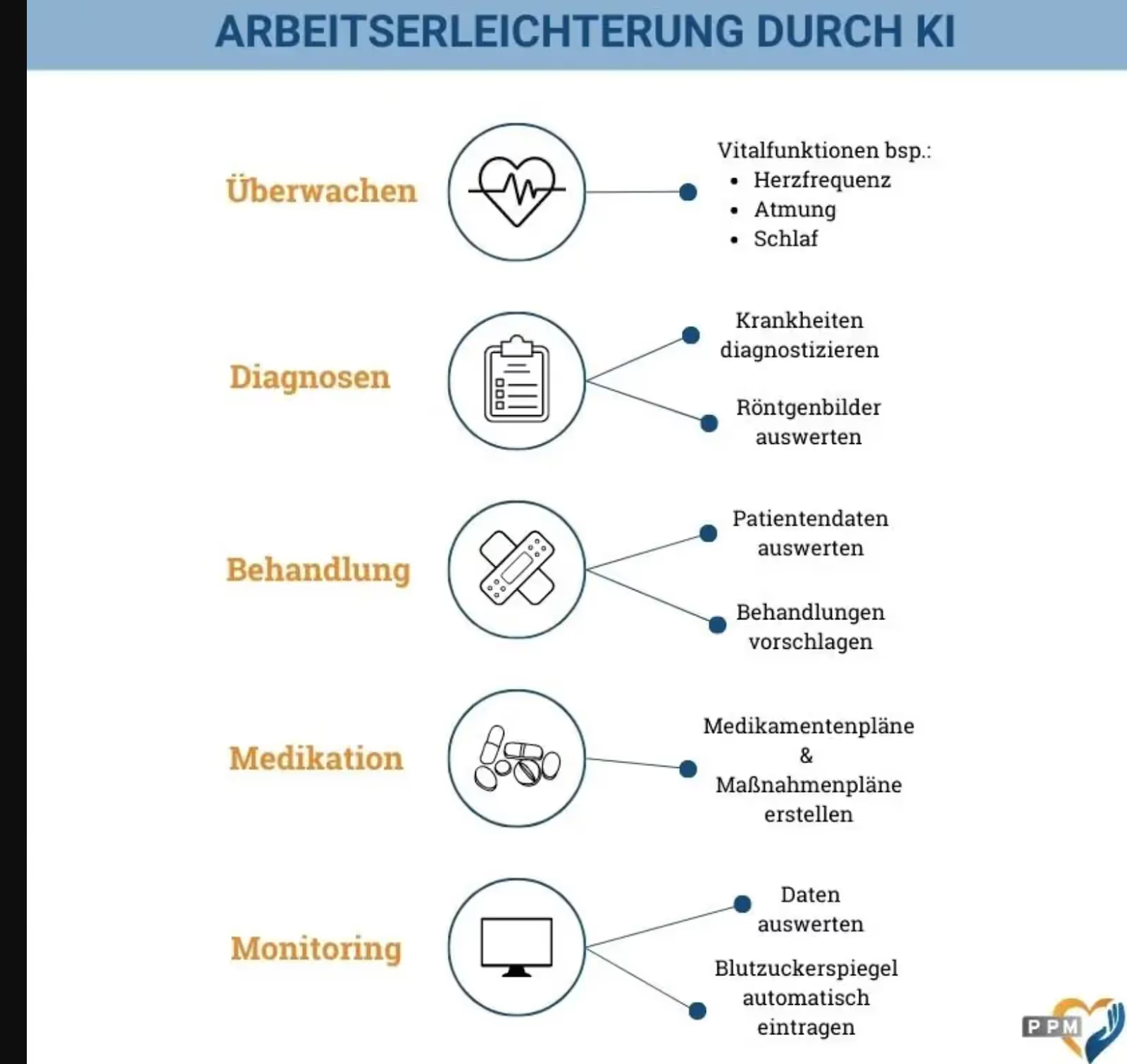
AI enables language models such as Chat GPT, speech-to-text, wearables and even augmented and virtual reality. This interactive map shows the various possible applications.
AI-supported documentation
Modern speech recognition tools can reduce the bureaucratic burden of care and thus working time by one hour per day, as a study by MyNewa shows. In this study, the vast majority of respondents report that they would welcome digital applications and advocate faster implementation.
A major obstacle is the lack of comprehensive digital infrastructure, as described in this podcast. This could enable apps such as Voize or nooa, which are already used for documentation, to connect with other applications.
Digital processes and interoperability based on examples
E-health and DIPAs (digital care applications)
Just as digital health applications (DiGA) already support patients with certain illnesses such as depression, DiPAs are digital applications that directly support patients in their care as part of the development of e-health. They can be used as an app, controlled by AI, to reduce the risk of falls, for example.
As we have already shown with wearables, there are a wide range of applications that are also widely accepted and can communicate with each other via the Internet of Things (IoT) , as demonstrated by VIVAICare from VivaiSoftware AG.
Digital assistance systems
The digital assistant is installed at home and can use AI to report falls, manage appointments and reminders, and conduct therapeutic conversations. Relatives are connected via an app and can monitor the person being cared for remotely. Research is also being conducted into systems that directly help patients and can sometimes be operated by the patients themselves. This promotes their independence.
VR and AR in care
Virtual Reality (VR) und Augmented Reality (AR) can support the training of nursing staff by using VR glasses to simulate applications and medical issues. They can also entertain patients, distract them from painful treatments or, for example, provide training in cases of dementia.
Robotics in care
Robots offer a physical component of artificial intelligence that can take on human-like functions through machine learning.
Social robots
Social robots such as Pepper, Navel and Oskar are being tested and are constantly evolving thanks to their integrated AI. One advantage is that robots have endless patience. However, the Oskar robot is not yet of much help to nursing staff.
Assistance robots
The Care-O-bot 4 from the Fraunhofer Institute also has entertainment functions and can interact. Thanks to its customisable arms, it can also fetch and distribute water, thus performing a vital task. It keeps track of the residents' water consumption, as shown here. Casero, also mentioned in the video, can handle transport tasks in the nursing home and also take on night-time patrols. Both of these tasks greatly reduce the workload of nursing staff.
Telemedicine applications
Robots are already capable of performing precise, predictable movements. In the future, robots will also be able to perform telemedicine applications, such as Garmi, a robot developed by the Technical University of Munich that is currently being used in a model apartment.
Exoskeletons in nursing care
Wearable robots are exoskeletons that also use sensors, actuators and control systems to support human movements. Exoskeletons are particularly helpful for carers because they can assist them in lifting patients, as Charité is currently testing. Research is also being conducted into applications for exoskeletons with thought transfer. These could, for example, help stroke patients to move again.
Ethical and social issues surrounding the use of AI in care
Despite the fascination with the possibilities, there are ethical and social questions that must be asked when using artificial intelligence. First, existing staff should be protected from feeling degraded and less professional. Therefore, further training and supervision should be introduced for existing and new professionals to prevent social decline. In return, human qualities should be emphasised.
Robots should not attempt to imitate human responsiveness, according to an article by drze. Since robots do not feel like humans, they cannot always adhere to moral boundaries and would deceive their counterparts with their imitation of empathy.
Handling generated data
Furthermore, the question arises as to where data is hosted and with whom it may be shared. At the same time, there is a risk of false diagnoses, cyber attacks or incorrect manipulation of AI. Chat-GPT, which is used for robot communication, among other things, should also be handled with caution because it can be manipulated with tricks and is still hardly critically reflected.
Cybersecurity issues must be addressed by appropriate specialists.
Changes in job profiles due to the use of AI and robotics in nursing
Digitalisation is therefore creating new job profiles, ranging from robotics engineers and technicians to data analysts and experts in legal and ethical issues. Nevertheless, nursing professionals retain their human expertise. With the appropriate training, they coordinate and monitor digital applications and remain indispensable with their empathy and communication skills.
Conclusion
Digital assistance systems, wearables, robotics and exoskeletons can significantly reduce the workload of nursing staff and also give those in need of care independence and mobility. However, human care and compassion cannot be replaced.
Ethical issues should therefore be made transparent and cybersecurity issues should be addressed by specialists. This requires experts who are trained or recruited through professional personnel consulting. The expertise of such personnel consulting can also support the transition for staff. This will ensure that a company is well prepared for the future of care in every respect.